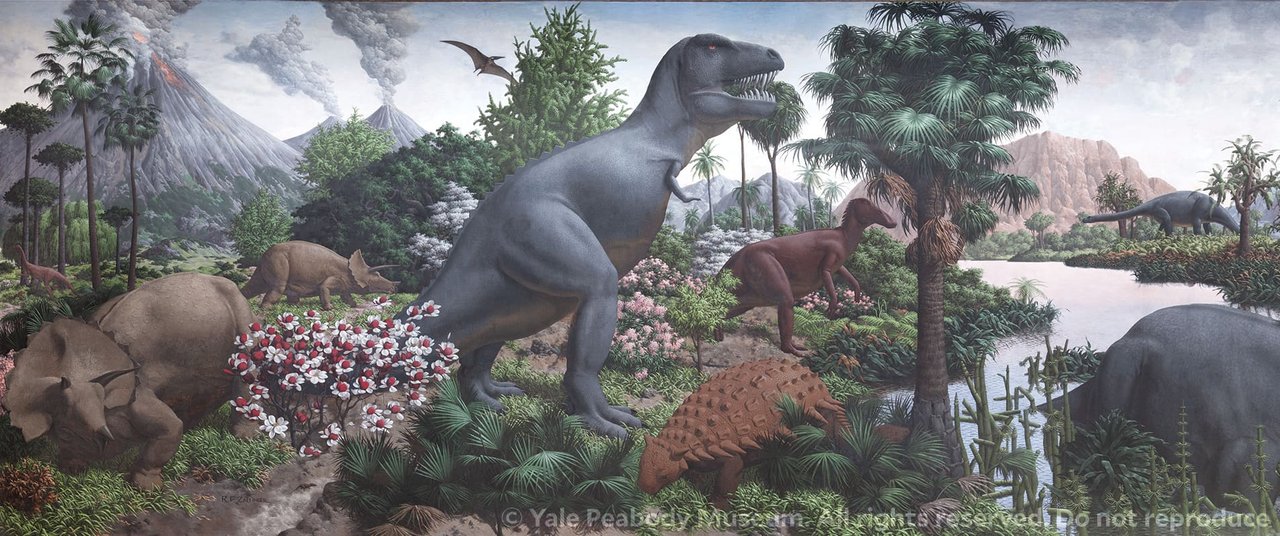
Begin at the entrance to Burke Hall, then walk far enough into the room to take in the Brontosaurus and the wall behind it at once. The skeleton occupies the center of the hall. Its neck reaches forward, its tail rises clear of the floor, and its long axis directs your eye toward Rudolph Zallinger's mural, "The Age of Reptiles." Specimen first, interpretation behind it: that pairing is the quickest way to understand the Peabody.
The museum takes work that usually happens in collections rooms, laboratories, and scholarly arguments and gives it a public form. A fossil skeleton shows what researchers assembled from physical evidence. The mural supplies a much larger story about geological time. The Peabody's institutional history traces that work from Yale's early teaching collections through the museum's founding in 1866, its current building, and the displays that became public symbols of Yale science.
The Brontosaurus mount was completed in 1931, using fossils associated with Yale paleontologist Othniel Charles Marsh's western expeditions. Marsh was central to the museum's early growth and became the first professor of paleontology in the United States. His rivalry with Edward Drinker Cope, later called the Bone Wars, accelerated the collection and naming of fossils in the late nineteenth century. Here, that history matters less as colorful personal drama than as an explanation for how western fossils entered eastern university collections.
Walk around the mount and look for the supporting armature and the joints where a museum has had to turn incomplete remains into a coherent animal. Do not assume that every visible element came from one individual or that a mounted pose is timeless. The skeleton is both fossil evidence and an interpretation assembled by people.
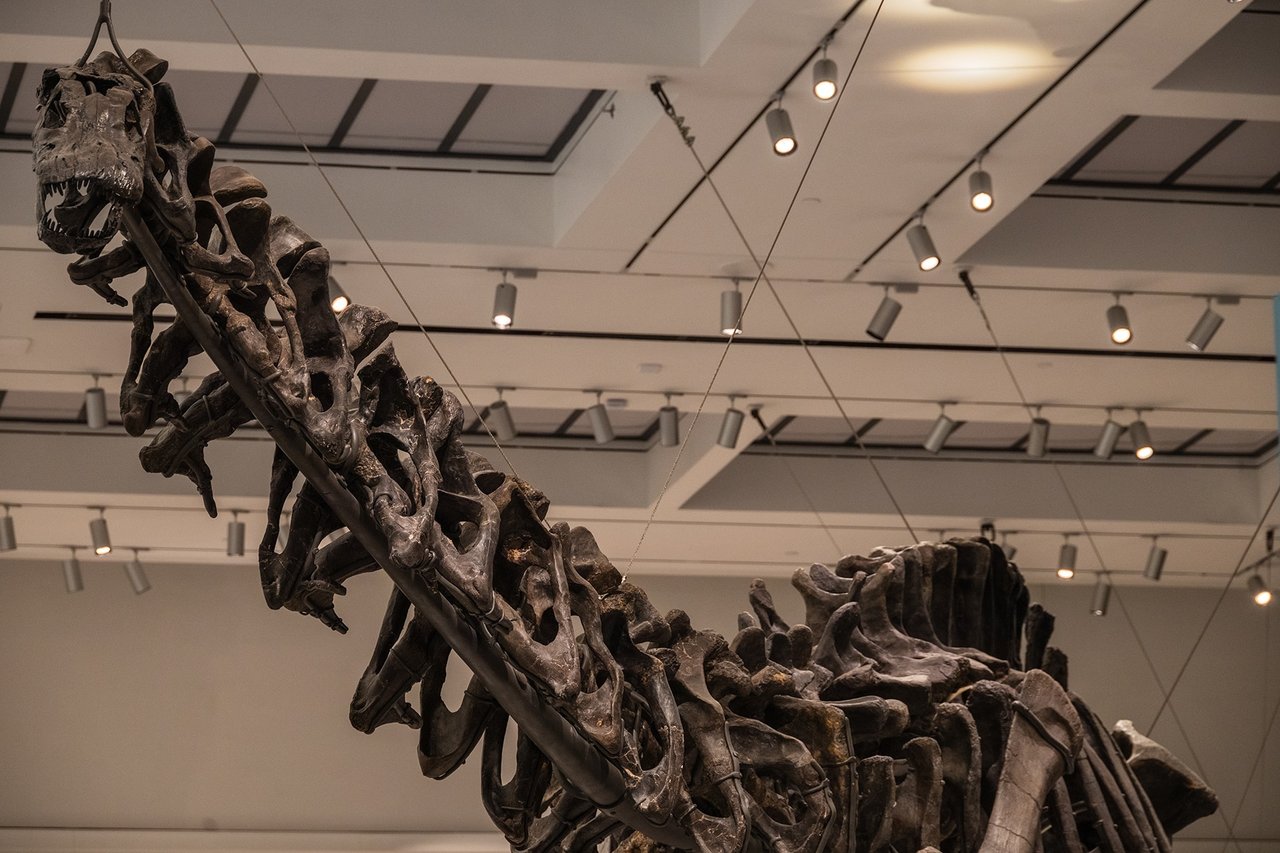
Yale's natural-history holdings reach back to the eighteenth century, but systematic teaching and research collections took shape after Benjamin Silliman became professor of chemistry and natural history in 1802. George Peabody's gift established the museum in 1866. The present building opened in 1925, with a two-story great hall sized for Marsh's large dinosaur specimens. By 1947, when Zallinger completed the mural, hall, skeleton, and image had become one public composition: architecture provided the viewing space, the mount supplied physical scale, and the mural supplied a timeline.
The mural: geological time pressed into one wall
Now turn to the long wall. "The Age of Reptiles" runs 110 feet and was painted in fresco secco, a method of working on dry plaster. Rather than separating geological periods into labeled boxes, Zallinger connected them through changes in animals, plants, and landscape. From normal viewing distance, the transitions feel continuous. Move closer and try to locate a boundary where one ecological world gives way to another.
The mural's achievement is spatial: hundreds of millions of years become a sequence that a visitor can follow by walking along a wall. Its images were informed by the science available when it was made, but the mural should not be treated as a permanently current diagram of prehistoric life. It is also an artifact of 1940s scientific visualization, showing how one generation translated evidence into a persuasive public scene.
Renovation: a new route through an old hall
The Peabody reopened on March 26, 2024, after a major renovation supported by Edward P. Bass and designed by Centerbrook Architects and Planners. Yale Capital Projects records an addition of about 66,000 gross square feet, bringing the building to roughly 171,500 gross square feet and increasing exhibition space by 50 percent. Individual admission is free, although hours and access conditions should always be checked before a visit.
The new Central Gallery makes the change legible. Its three-story volume, crossings, and places to pause connect old and new rooms while offering several viewing heights. A higher-level route also gives visitors a more nearly eye-level encounter with parts of Zallinger's mural. From the floor, the skeleton and mural register first as scale and spectacle; from above, individual figures and transitions become easier to inspect.
The Brontosaurus was remounted during the renovation. Its revised spine and raised tail reflect a changed scientific understanding of the animal's posture. The fossils did not become different fossils, but the public image assembled from them changed. That is a useful lesson to carry through the museum: scientific displays are arguments that can be revised.
Scientific instruments: another history of knowledge
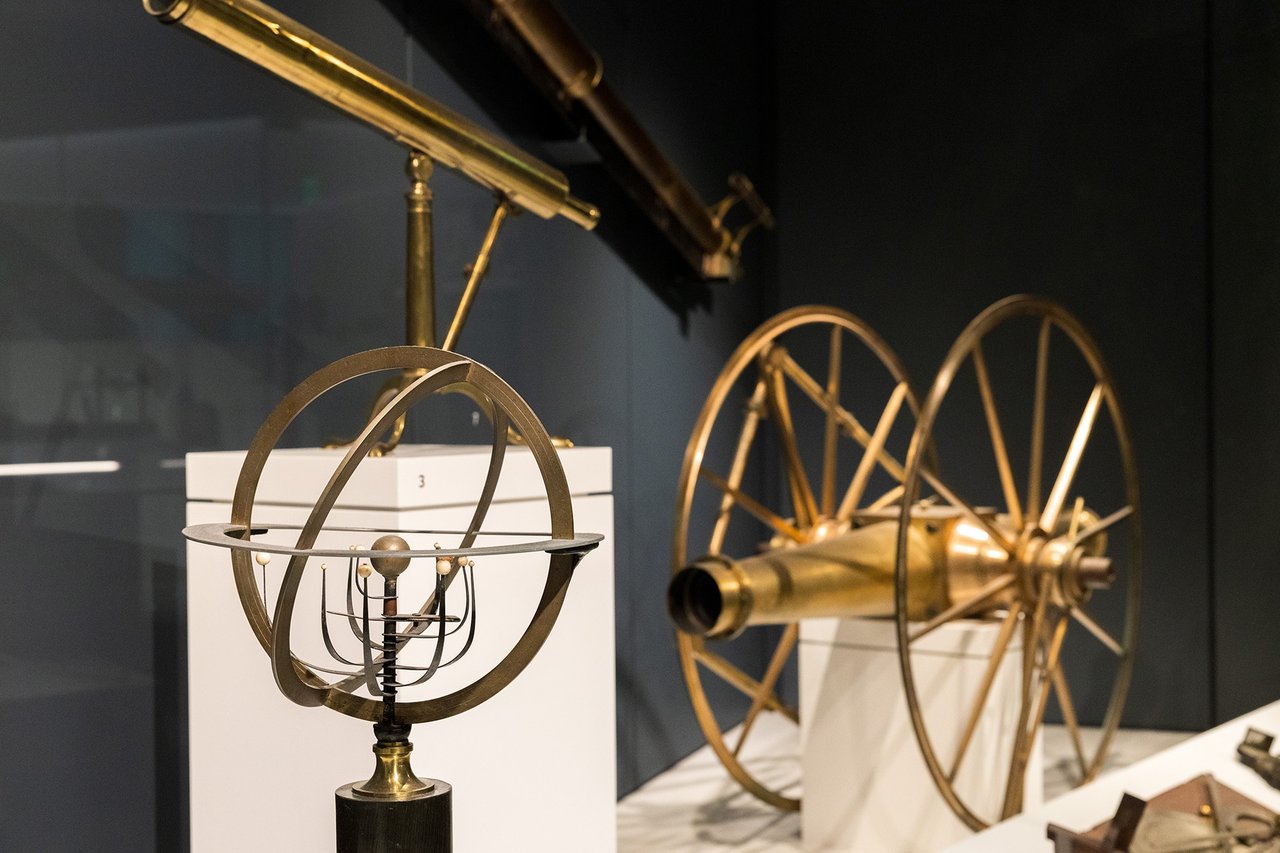
Upstairs, the History of Science and Technology collection shifts the scale from dinosaurs to tools. The collection holds about 15,000 objects spanning more than five centuries, according to the Peabody's collection overview. Astrolabes, microscopes, telescopes, balances, recording devices, and other instruments show science as repeated work: measuring, adjusting, recording, teaching, and checking.
Choose one modest instrument rather than the most dramatic object. Look for a scale, a moving joint, worn surfaces, or a repair. These details reconnect a museum object to the ordinary actions that once made it useful. Burke Hall presents the visible outcome of collecting and reconstruction; the instrument cases reveal procedures that produced observations in the first place.
This creates a productive comparison with Beinecke Library. Beinecke turns preservation into visible architecture through stone, glass, structure, and controlled access. The Peabody turns the making and revising of scientific knowledge into public display through mounted specimens, images, instruments, and changing visitor routes. Both make normally backstage work available for inspection.
Five field questions
- From which position can you see the Brontosaurus and "The Age of Reptiles" as one composition, and what changes when you move beneath the skeleton?
- Where does one geological period become another in the mural, and which changes in plants, terrain, or animals create the transition?
- How does an upper-level view of the mural differ from looking up from the hall floor?
- Which instrument most clearly records repeated use through a scale, moving part, worn surface, or repair?
- In one view of Burke Hall, what evidence can you find of collection, interpretation, remounting, and public display?