Standing on the High Street sidewalk before Sterling Memorial Library's main entrance, you notice two pointed arches cut into a thick stone wall. Above them rise stained-glass windows, and between the doors stands a stone figure of a medieval scholar, head bowed toward a book. The composition borrows visual grammar from a cathedral portal—arches, colored glass, and a reverent figure—yet redirects that weight toward a library. Before you even enter, the building prompts you to approach scholarship with something like religious seriousness.
This architectural language goes by the name of Collegiate Gothic. American universities adopted it widely during the early twentieth century to connect relatively young campuses to the visual lineage of Oxford and Cambridge. Completed in 1931 to designs by James Gamble Rogers, Sterling stands as one of Yale’s most complete expressions of that strategy. As Yale Library’s architectural history points out, the structure performs a clear double act: steel framing, heating and cooling, pneumatic tubes, and other modern systems were concealed behind stone, ornament, and glass. What presents itself as ancient is the public face of a thoroughly modern research machine.
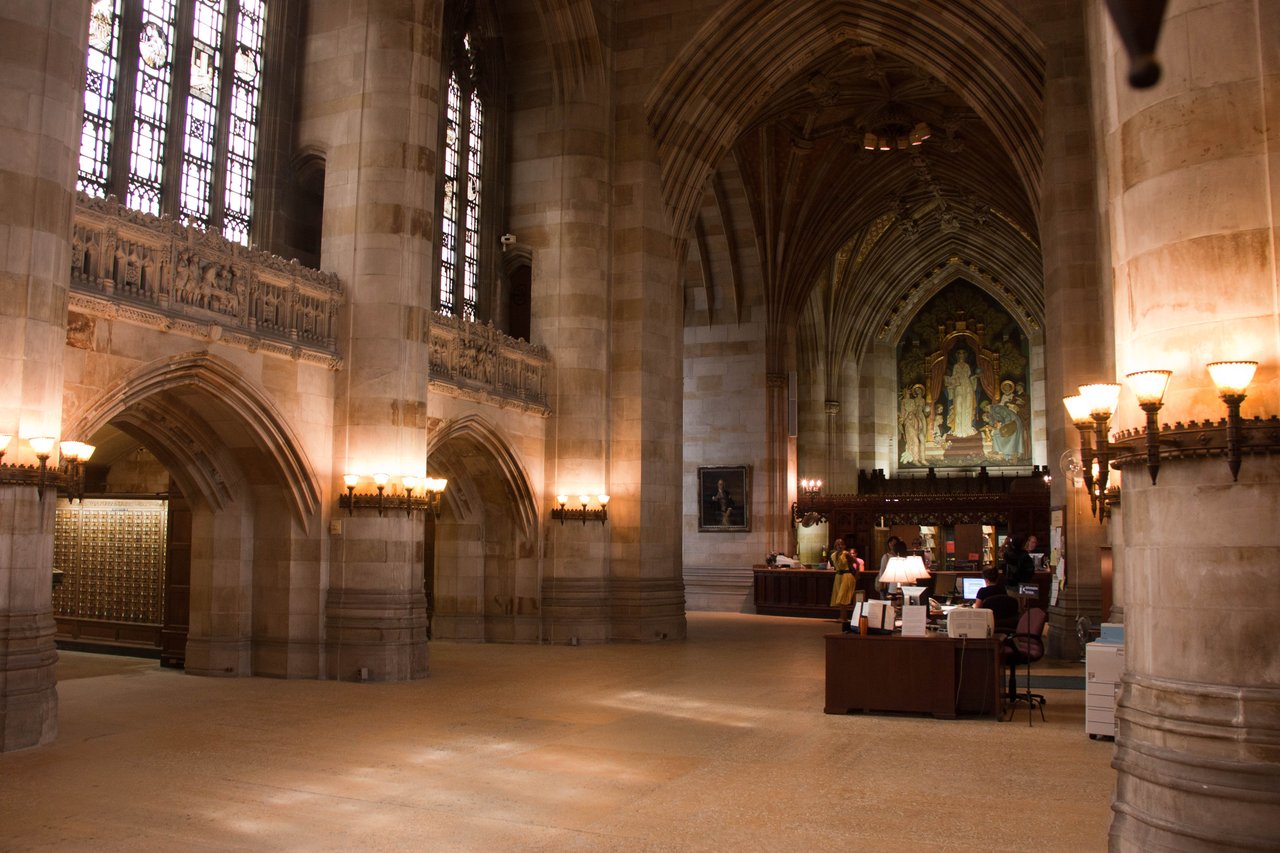
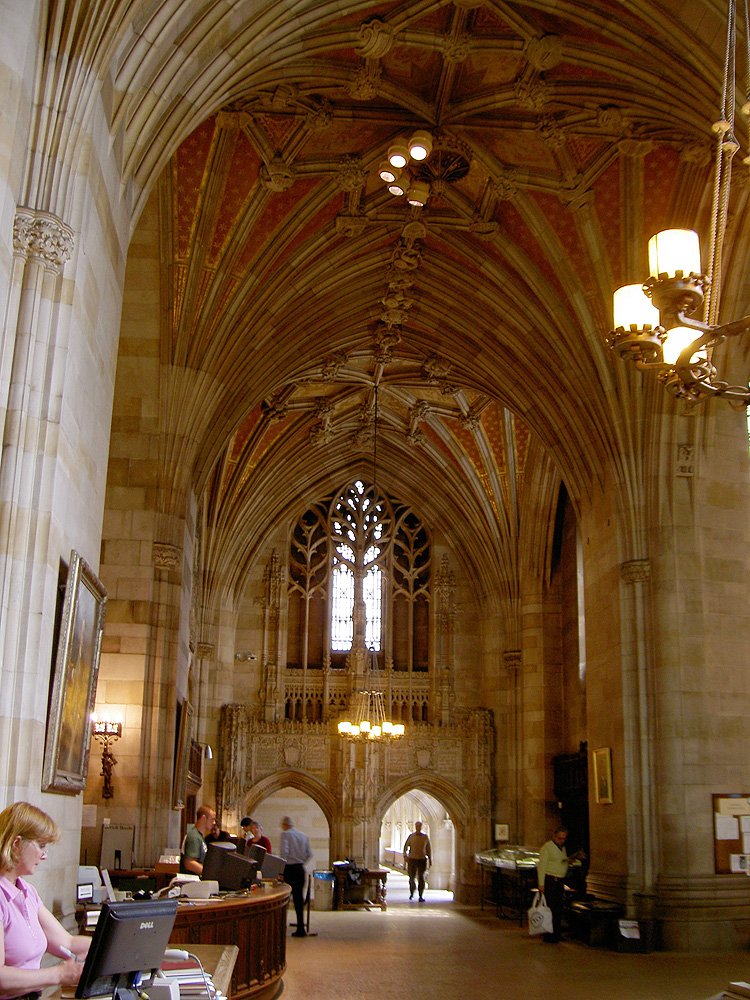
Step inside, and the entrance opens into a tall hall designed as a nave. Borrowed from church architecture, a nave is the long central space meant to carry a visitor forward toward an altar. Here at Sterling, columns, vaults, and stained glass pull your eye along the hall toward the old circulation desk and the entrance to the stacks. Yale’s account of the entrance and nave explicitly describes this intended impression of entering a Gothic church. The destination, however, is not an altar. It is the service point where readers once requested and received books. The plan gives library work the ceremonial weight of worship without pretending that the building is actually medieval.
Along the space, stone reliefs by René P. Chambellan depict forms of scholarship and intellectual life. Around them, stained glass designed by G. Owen Bonawit turns decorative windows into a catalog of knowledge. Yale records roughly 3,300 leaded stained-glass windows across the building, with subjects ranging through literature, local history, university imagery, and themes connected to specific rooms and disciplines. The safe way to read them is not as a complete classification system that every visitor can decode, but as a visual program that makes academic subjects part of the architecture.
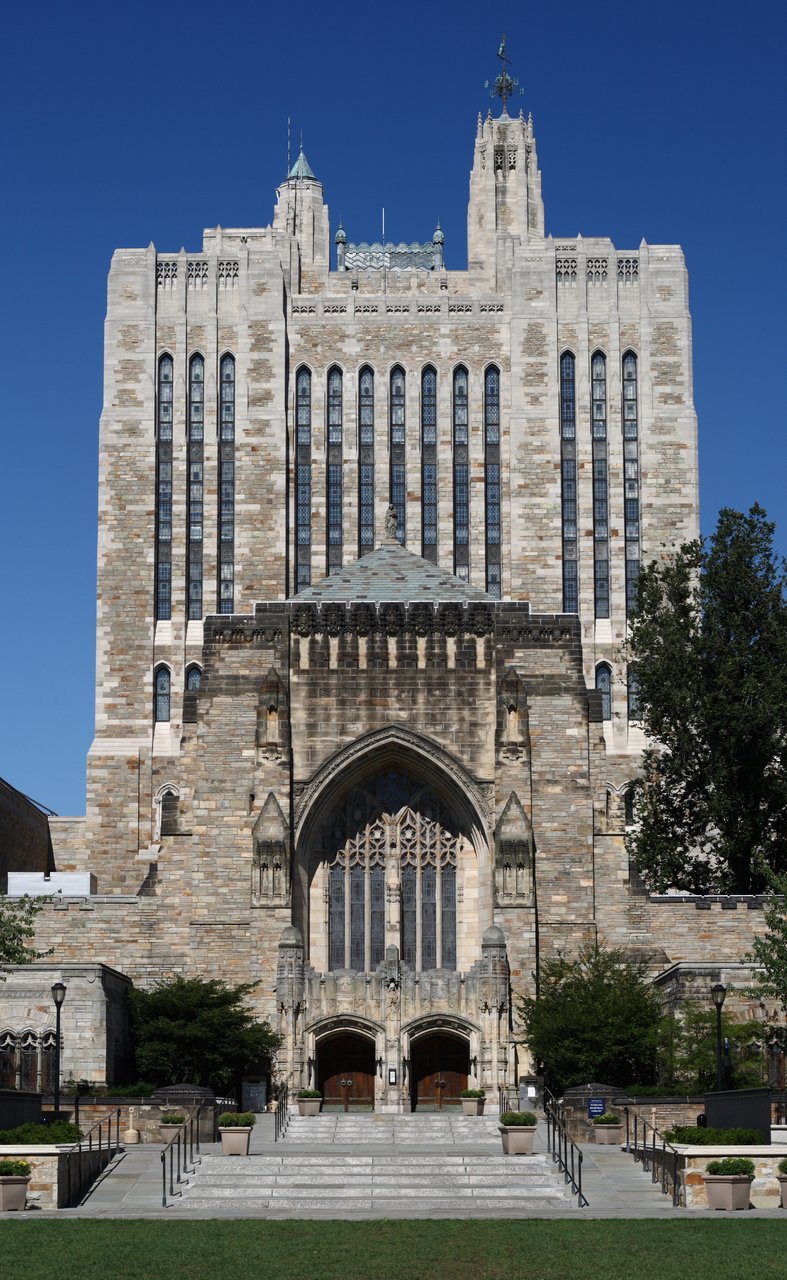
Now move back outside to Cross Campus and look for the taller mass rising behind the main building. This is the stack tower: 150 feet high, divided into sixteen stack tiers, and originally designed for a collection of 3.5 million volumes. Yale’s history of the stacks describes its welded-steel construction as the largest welding project of its kind at the time. That period qualification matters; it is evidence of contemporary ambition, not a permanent world record.
The contrast is the key to understanding the building. Outside, the tower continues the campus's stone Gothic language. Inside, welded steel supports densely arranged bookshelves. The envelope allows the tower to look like part of an old collegiate skyline, while its working core answers the engineering demands of a twentieth-century research library.
The stacks also explain another hidden system. In the original library, a request written at the circulation desk could travel through a pneumatic tube to staff working in the tower. Retrieved books then moved through a conveyor system toward the reader. The machinery stayed behind the walls, allowing the public room to remain visually calm. A pneumatic-tube station returned to view after the 2024 restoration of the L&B Room, offering a rare physical trace of that earlier logistics network.
The former circulation desk therefore occupied more than a symbolic position. It linked the ceremonial public hall to the practical work of locating and moving books. It served both as the visual conclusion of the nave and as an interface to infrastructure that most readers never saw.
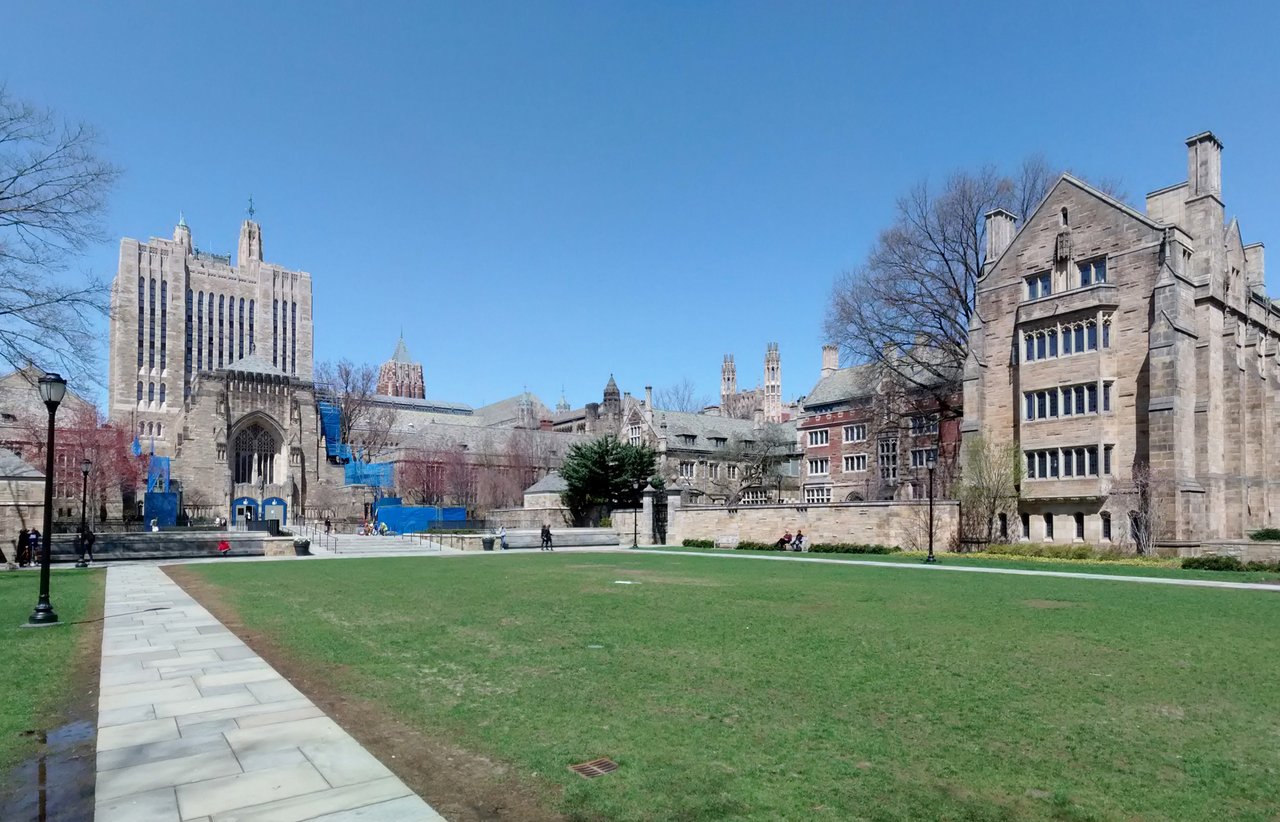
Sterling later expanded downward as well as upward. Cross Campus Library, now Bass Library, opened beneath the lawn in 1970 and connects to Sterling below grade. From the lawn, its sunken entrance shows a second way to enlarge knowledge infrastructure after the stone composition above ground had become a protected campus landmark. Sterling stores books in a disguised tower; Bass extends reading and storage space beneath an apparently open landscape.
One more authorship detail complicates the story. Yale’s architectural tour traces Sterling’s basic idea to Bertram Grosvenor Goodhue: a low, emphatically Gothic library with a stack tower behind it. Rogers developed that concept and reorganized the interior around a nave-like route to the reference desks. It is therefore more accurate to credit Goodhue with an originating concept and Rogers with the executed design than to collapse the history into a single name.
End by walking from Sterling to Beinecke, less than a few minutes away. Beinecke turns protection into a visible system of translucent marble, structural grid, and a glass book tower. Sterling does nearly the opposite. It hides steel, environmental systems, retrieval machinery, and dense storage behind a historical skin. The difference is not simply old style versus new style. Each library proposes a different relationship between knowledge and authority: one displays the mechanisms of protection; the other lets inherited architectural language absorb them.
Five field questions
- At the High Street entrance, which features make the library resemble a church portal, and which details reveal its academic purpose?
- Inside the nave, where does your eye travel, and how does the former circulation desk use a position comparable to an altar’s?
- Choose one stained-glass window. What subject can you identify, and how confidently can you connect it to the room or discipline around it?
- From Cross Campus, compare the stack tower with the sunken Bass Library entrance. How do the two forms conceal storage in different directions?
- Walk between Sterling and Beinecke. Which building makes its working systems easier to see, and how does that difference shape your trust in the institution?